
.svg)



.svg)
Creators Who Trust TagMango
.avif)
Ganeshprasad
Sridharan
.avif)
Ankur
Warikoo

Siddharth
Rajsekar

Dhruv
Rathee

Surendran
Jayasekar

Ranveer
Allahbadia

Kavya
Karnatac

Akshar
Yoga

Harsh
Dave


Riddhi
Deorah

Dinaz
Vervatwala

Astro
Arun Pandit

Gayathri
Shivaram

Aakanksha
Monga
Ganeshprasad
Sridharan
Ankur
Warikoo
Siddharth
Rajsekar
Dhruv
Rathee
Surendran
Jayasekar
Ranveer
Allahbadia
Kavya
Karnatac
Akshar
Yoga
Harsh
Dave
Riddhi
Deorah
Dinaz
Vervatwala
Astro
Arun Pandit
Gayathri
Shivaram
Aakanksha
Monga
Skool gives you a community.
TagMango gives it a purpose.
Payment
Infrastructure
.png)
Indian creators have reported held payouts for 6+ months because of it.
Your students pay the way they want. You get paid without workarounds.
.webp)
Hidden
Costs

Until you realise it does not have email marketing, landing pages, or upsells.
The Hobby plan gives you exactly 1 admin account.
All to patch the holes Skool left behind.
.webp)
Building
Blind
Your students download
Skool's app.
One terms update and everything you built is theirs to keep.
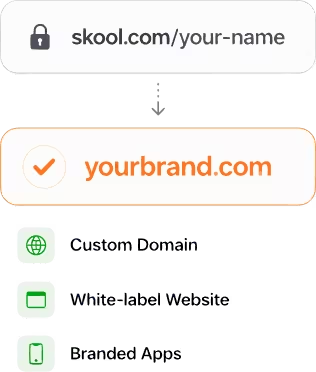
On TagMango, you get a custom domain, white-label website, and branded apps.
All yours.
Community
Or Chaos?

Sales pages in disguise.
You paid for this, only to have no say in who you stand next to.
On TagMango, your community is built by people who actually chose you.
.webp)
.webp)

.svg)
.svg)
.svg)
.svg)


They outgrew Skool. Here is what happened next.


You built the community. Skool built the walls around it.
Everything Skool made you work around. Built in.


.avif)
.avif)
.avif)
.avif)
.avif)
.avif)
%20(1).avif)
Switching from Skool to TagMango?
Here is how simple it is.
Switching from Skool to TagMango? Here is how simple it is.
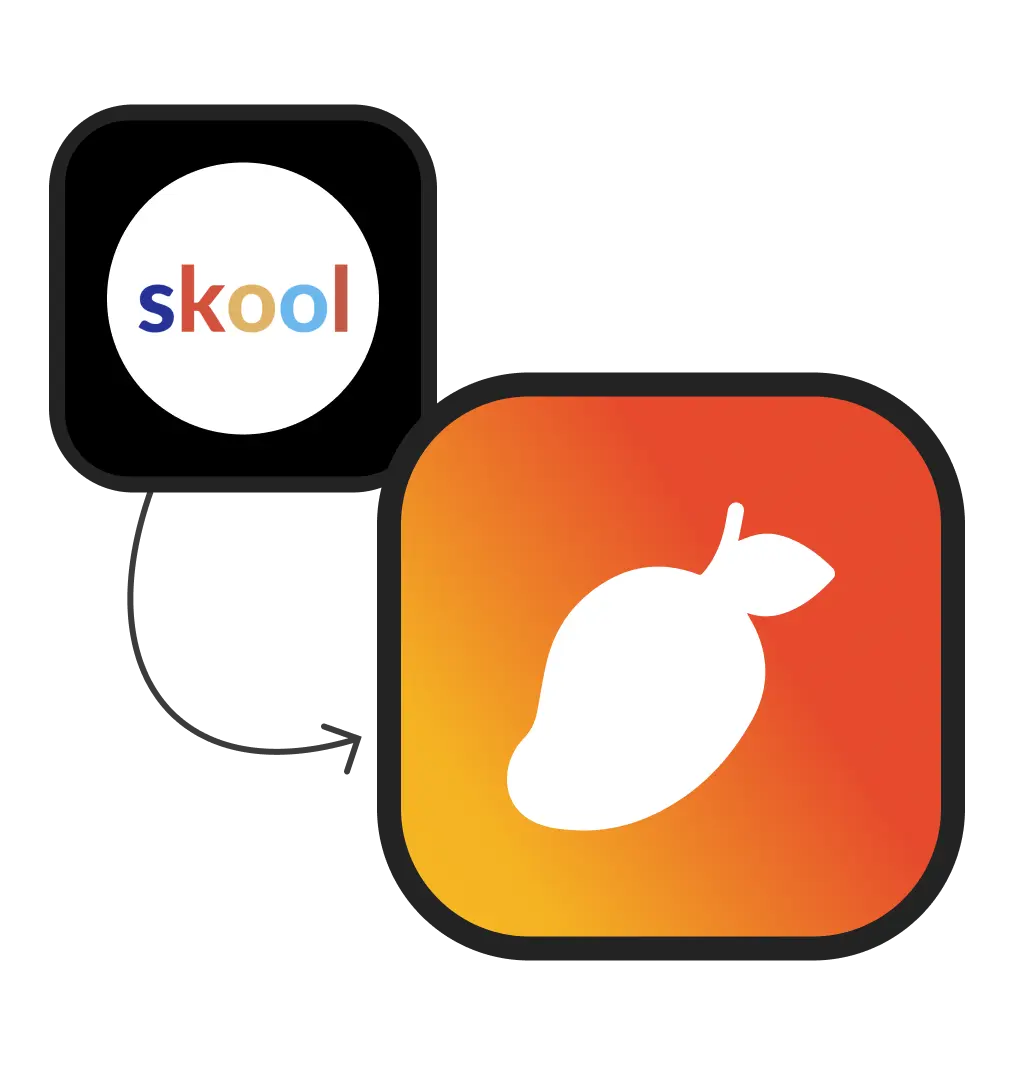
Export your student data from Skool
Upload your content and link
You are live
Hear It From the Creators
.avif)
Dr. Sunil
Jindal
.avif)
Sandeep
Bhansali
.avif)
Alok
Taunk
.avif)
Saiyami
Juvekar
.avif)
PRITAM
PATIL

PRAVEEN
CALVIN
coaching and scaling.
.avif)
KSHITIJ
Doval
I even hired someone just to maximize every feature it offers.
.avif)
Ramya
Sundar

Kamlesh
More
.avif)
KARTIK
MUKHERJEE
TagMango made it happen.
Dr. Sunil
Jindal
Sandeep
Bhansali
Alok
Taunk
Saiyami
Juvekar
PRITAM
PATIL
PRAVEEN
CALVIN
coaching and scaling.
KSHITIJ
Doval
I even hired someone just to maximize every feature it offers.
Ramya
Sundar
Kamlesh
More
KARTIK
MUKHERJEE
TagMango made it happen.
Still thinking?
.svg)
Does TagMango offer a free plan? What does it include?

.svg)
.svg)
Yes, and it is genuinely free. Not a stripped-down trial.
TagMango's free plan has no fixed monthly cost. You pay a 10% commission only when you make a sale, which means you pay nothing until you earn something. The free plan includes unlimited courses, unlimited students, unlimited services, landing pages, community feed, chat rooms, email and WhatsApp automation, certificates, and Zapier and Pabbly integration.You get the full platform with a 20GB media upload limit. It is the lowest-risk way to explore TagMango as a Skool alternative before committing to a paid plan. Most creators who start on the free plan upgrade within the first 60 days because the platform sells itself.
What is the biggest difference between TagMango and Skool?
Skool is built around community. TagMango is built around your coaching business.
Both give you a community feed, courses, and gamification. But the moment you want to run a serious coaching business, Skool asks you to go elsewhere. No WhatsApp automation. No checkout upsells. No completion certificates. No branded app under your name. No local payment support for creators outside the US.
TagMango is the Skool alternative built specifically for coaches and creators who want to teach, sell, and grow without stitching five different tools together. Everything lives in one place. Under your brand. On your terms. It is why so many creators searching for alternatives to Skool land on TagMango every month. Not because Skool is bad. Because their coaching business needed more than Skool was built to give.
Skool says "Discover communities." TagMango says "Create Freedom." What is the difference?
Everything.
Skool's world is built around discovery. Find a community. Join a feed. Level up through engagement. It is a great model if what you want is to be part of something someone else built.
TagMango's world is built around ownership. Your brand. Your domain. Your app. Your payment gateway. Your affiliate system. Your automation. Your students. Yours.
Skool puts you in a marketplace and hopes people find you. TagMango gives you the infrastructure to build something that is entirely, irreversibly yours. One platform helps you discover communities. The other helps you build a coaching business that nobody can take away from you.
That is not a tagline difference. That is a philosophy difference. And for serious coaches and creators, it is the only one that matters.
Is TagMango more expensive than Skool?
Not when you count what you actually need to run a coaching business.
Skool's Hobby plan starts at $9 per month. Sounds simple. But it takes a 10% cut of everything you earn. At just $1,000 a month in revenue, that is $100 gone before you have paid for a single tool Skool does not include. And Skool does not include email marketing, WhatsApp automation, a landing page builder, or checkout upsells. Most creators doing a Skool vs TagMango comparison end up realising that most Skool users pay for three or four additional tools on top of their Skool plan just to run their coaching business properly.
TagMango starts completely free. Zero fixed cost. You pay a 10% commission only when you earn. And everything you need, email automation, WhatsApp campaigns, landing pages, upsells, and affiliate tools, is already built in. As you grow, plans scale from Rs. 5,000 per month with 5% commission all the way to Rs. 30,000 per month with zero platform commission and a 1.5% domestic payment gateway fee. One platform. One bill. Nothing missing.
Is TagMango a good Skool alternative for coaches and course creators?
If coaching is your core business, TagMango is not just a good Skool alternative. It is a more complete one.
Skool gives you a course player with basic drip content that unlocks by days after joining. No quizzes. No assignments. No completion certificates. No DRM protection for your videos. No downloadable resources per lesson. No course progress analytics beyond a basic completion percentage.
TagMango gives you drip content by specific date or completion, quizzes, assignments, DRM-protected video hosting, automated completion certificates, detailed progress reports, and downloadable resources per lesson. If your courses are a core revenue driver and not just a community add-on, TagMango gives you the depth Skool treats as an afterthought.
How does TagMango handle payments compared to Skool?
This is where the Skool vs TagMango difference hits hardest for creators outside the US.
Skool processes payments through its own system. No Razorpay. No UPI. No GST invoicing. For Indian creators and those across South and Southeast Asia, this means workarounds, external payment tools, and a checkout experience that does not reflect how your students actually pay.
TagMango has Razorpay, UPI, Stripe, and Cashfree built in natively. INR pricing is standard. GST invoicing is automatic. You can offer no-cost EMI for high-ticket coaching programs, set different prices for international students, and accept payments from anywhere in the world. All from the same platform. No workarounds. No extra tools. It is one of the most significant reasons creators look for Skool alternatives in the first place.
Does TagMango have WhatsApp integration?
This is one of TagMango's sharpest advantages over Skool, and it is not a minor one.
WhatsApp is where your students live. Skool has zero native WhatsApp support. Every reminder, follow-up, and re-engagement message has to happen through a third-party tool bolted onto your workflow.
TagMango has WhatsApp automation built directly into the platform. Automated purchase confirmations, session reminders 24 hours before, 30 minutes before, and 15 minutes before. Course completion nudges. Subscription renewal reminders. Broadcast campaigns to your entire student base or specific segments. All set up once. All running while you focus on coaching. For creators evaluating Skool competition, this alone is often the deciding factor.
Can I run 1:1 coaching alongside my community on TagMango?
Yes, and it is all in one place. No Calendly. No separate booking tool. No juggling links.
TagMango has a full 1:1 consultation infrastructure built directly into the platform. You create your availability slots, set buffer times so you are never caught off guard with a last-minute booking, connect it to your service, and your students book directly from inside the platform. Automated email reminders go out before every session. Everything is tracked, recorded if needed, and managed from your dashboard.
Skool has no native 1:1 booking infrastructure of any kind. If you offer coaching calls or clarity sessions on Skool, you are sending your students to an external tool and hoping the experience holds together. On TagMango, the whole journey from purchase to session to follow-up happens in one place. It is one of the clearest functional gaps between Skool and TagMango for working coaches.
Can I offer EMI or installment options to my students?
Yes. And for high-ticket coaching programs, this changes everything.
If you are selling a Rs. 20,000 or Rs. 50,000 coaching program, the difference between asking for a lump sum and offering no-cost EMI is often the difference between a lost sale and a converted one. Skool has no EMI or installment option of any kind.
TagMango has no-cost EMI built in on the Advanced plan and above for services priced above Rs. 6,000. The interest is borne by you as the creator, but the conversion uplift on high-ticket programs more than covers it. Your student pays in comfortable instalments. You get the full amount. Everyone wins. It is one more reason TagMango stands out as the best Skool alternative for coaches selling premium programs.
Can my students become my affiliates on TagMango?
Yes. And this is one of the most powerful things TagMango does that Skool simply cannot match.
Skool has a basic member referral system. A student refers a friend and gets a credit. That is the beginning and end of it.
TagMango has a full affiliate infrastructure. You set custom commission percentages per product. You can enable lifetime linking, which means if a student refers a friend and that friend buys another course six months later without using the affiliate link, your student still earns the commission. Every future purchase. Automatically.
Your most engaged students become your most motivated marketing team. Your customer acquisition cost drops. Your community grows. All without spending an extra rupee on ads. It is one of the clearest reasons serious coaches choose TagMango over Skool as their platform of choice.
Will I outgrow Skool if my coaching business takes off?
It is one of the most common reasons creators switch and one of the most searched questions among those looking for Skool alternatives.
Skool works well when your business is simple. But the moment you want to run multiple products, offer different tiers of access, automate your marketing, give students a branded app experience, or accept payments the way your audience actually pays, you hit walls. And every wall costs you a new tool subscription.
TagMango is built to scale with you from day one. Start on the free plan. Add automation, affiliates, upsells, and a branded app as your coaching business grows. You never have to re-platform. You just unlock more of what is already there.
Does Skool's discovery feature work for or against you?
It can, and it is worth thinking about seriously.
Skool became heavily associated with the business influencer and hustle-culture space following Alex Hormozi's involvement. Because Skool has a public community discovery directory, your brand appears alongside every other community on the platform, whether you like it or not.
For coaches and educators running professional programs where trust and credibility matter, that association can work against you before a potential student ever clicks through to your page. It is one of the less-discussed reasons creators look for Skool competitors and alternatives.
On TagMango, your brand is your brand. Your students find you through your custom domain, your white-label website, and your branded app. TagMango stays invisible. You stay front and centre.
What does it actually feel like for students to be on TagMango versus Skool?
On Skool, your student opens the App Store, searches for "Skool," downloads the Skool app, and then finds your community somewhere inside it. Your brand is secondary. Skool's brand is primary.
On TagMango Enterprise, your student searches for your academy by name, finds your app, downloads it, and lands directly inside your world. Your logo. Your colours. Your name in the App Store. Not TagMango. Not anyone else. You.
That difference sounds small until you think about what it signals to your student. One experience says you are a vendor inside someone else's platform. The other says you are a brand worth downloading. For coaches building premium programs where first impressions matter, that moment in the App Store is worth more than any feature comparison.
It is the difference between being hosted and being owned. And it is exactly why creators who take their coaching business seriously choose TagMango over Skool.
Do I actually own my content and student data on Skool?
Not fully. On Skool, your community lives at skool.com/your-name. Your content sits on their servers. If Skool changes its terms, raises prices, or decides to shut down your community, you have limited recourse and no easy way to take your audience with you.
On TagMango, you get your own custom domain, your own white-label website, and full control over your student data. You can export your member list anytime. Your coaching business is portable from day one. The difference between owning your platform and renting space on someone else's is the most important decision a serious creator makes. TagMango puts you on the right side of it.
How do I migrate from Skool to TagMango? Will I lose anything?
Switching platforms sounds scary. It does not have to be.
Here is exactly what the migration process looks like, step by step.
Step 1: Export your member data from Skool. Go to your Skool admin panel and export your member list as a CSV file.
Step 2: Set up your products on TagMango. Before you import your students, create the courses, workshops, or memberships on TagMango that mirror what your students purchased on Skool.
Step 3: Upload your CSV and link your members. Upload your member list to TagMango and link each group of students to the relevant product they purchased. TagMango handles the user data migration on its end. Your students receive a login notification and access their content immediately.
Step 4: You are live. Your students log in, find their courses, and pick up exactly where they left off. Nothing lost. Nothing missing.
Most creators complete the full migration within one to two days. If you run into anything during the process, TagMango's support team is available to help you through it.
One honest note: Skool does not have a formal content export tool. Your videos, lesson text, and course structure will need to be re-uploaded to TagMango manually. The student data migration is simple. The content migration requires your own files. If your content is already saved on your own drive, which it should be, this is straightforward.
The real question is not whether migration is possible. It is whether staying on Skool is worth the cost of everything you are not getting. For most coaches who make the switch, the answer becomes obvious very quickly.
